

The clearest veranda roof isn’t automatically the best choice for your home. If you’re searching for the best veranda roof material UK homeowners can choose, start by balancing daylight, shelter and control in changeable weather.
Appearance and light matter, but so do the way you’ll use the space and whether you want permanent cover or the option to open the roof. The covering can also affect how much daylight reaches the rooms beyond. Each choice involves a different balance, so compare materials and roof formats separately.
This guide compares polycarbonate and glass coverings, as well as folding roofs, by their practical benefits and trade-offs. GRV’s Bosco Polycarbonate Roof System, Pigato Glass Roof Pergola System and Verdeca Folding Roof offer examples of these options. Use the guidance to create a shortlist around your home, site and plans for the space.
Key Takeaways
- The best veranda roof material UK homeowners choose depends on their space, intended use and preferred balance of daylight, shelter and control.
- Glass and polycarbonate are covering materials; a folding roof is a format. Compare each system’s published specifications before weighing performance.
- Use daylight, weather protection, openness, roof control and upkeep as practical criteria when narrowing your options.
- Record your site dimensions, attachment context and preferred layout to make product comparisons more relevant.
- Once you know your priorities, compare GRV’s Bosco Polycarbonate Roof System, Pigato Glass Roof Pergola System and Verdeca Folding Roof.
Best veranda roof material UK: what should your roof do?
The right veranda roof balances shelter, daylight, appearance and control. Prioritising one without considering the others can leave the space less useful than you intended. A clear covering may help preserve a brighter feel, while an adjustable roof gives you the option to change its position. The best veranda roof material UK homeowners choose is the one that fits the house, site and way they plan to use the space.
A veranda roof covering helps shape how much light enters the space and how it is protected. The result also depends on the system’s design and specifications. Conditions vary across the UK, and a site may face wind-driven rain, strong sun or both at different times of year. Consider your garden’s aspect and exposure rather than assuming every roof faces the same demands. For broader architectural context, see History and types of verandas.
Start with the way you want to use your veranda
Picture an ordinary day in the space. If you mainly want a sheltered area for meals, put reliable overhead cover high on your list. If you want a flexible place for reading, relaxing or entertaining, consider how much daylight you want and whether you’d value being able to adjust the roof. Think beyond summer, too. Note when you expect to use the veranda in spring, autumn and during brighter or wetter spells. Comfort depends on the whole setting, not just the roof.
Rank these priorities separately: weather protection, openness to the sky, daylight above the veranda and in the rooms beyond, and control over the roof. A ranked list makes trade-offs clearer when you compare systems.
Separate roof material from roof format
Material describes what the roof covering is made from, such as glass or polycarbonate. Format describes how the roof operates. A fixed roof stays in place, while a folding roof can be opened or closed according to its design. These are separate parts of the decision: folding is a roof format, not a material category. Neither a material name nor a format guarantees a particular result, so compare the published specifications of each product.
Use this quick brief before looking at options:
- Cover: Is dependable overhead protection your main priority?
- Light: How much daylight do you want above the seating area and indoors?
- Openness: Do you prefer permanent cover or a more open feel when conditions allow?
- Control: Would you value being able to change the roof position?
There’s no single answer for every home. Start with your layout, the direction and exposure of the site, and the veranda’s everyday purpose. Then weigh those priorities against the exact specifications of the systems you’re considering. This gives you a practical basis for choosing, rather than relying on material names alone.
Veranda roof materials compared: polycarbonate, glass and folding systems
Compare roof options by what they let you prioritise, not by assuming one category is always superior. Polycarbonate and glass describe covering materials. Folding describes how a roof operates. Keeping these terms separate helps you compare like with like and avoid choosing by a label alone.
Material and operating format are separate decisions: one describes what covers the roof, the other describes how the roof opens or stays in place.
| Option | Category | What to focus on |
|---|---|---|
| Polycarbonate | Roof-covering material | Compare finish, published light-transmission information and care requirements. |
| Glass | Roof-covering material | Consider the look you want and review the exact product details for light and upkeep. |
| Folding roof | Operating format | Consider whether changing the roof position suits your plans, then review how the specific system operates. |
The table is a starting point, not a performance ranking. Construction, specification and design differ between products, so use product information to assess the details that matter for your project. For broader context on building materials and performance, the Building Research Establishment (BRE) offers information on building science and research. It isn’t a veranda product comparison, so use the relevant product specifications for your final assessment.
Polycarbonate veranda roofs: what to compare
Polycarbonate is a covering material, and the complete roof system includes more than the panels. Compare the published details for the finish, light transmission and care requirements of the particular option. These details help you assess whether the roof may suit your preferred look and maintenance routine. Polycarbonate coverings can differ in construction and performance, so use the product specification for the system you’re considering rather than generalising from the material name.
Glass and folding veranda roofs: different kinds of choice
Glass is a material choice. A folding roof is an operating format, so the two aren’t interchangeable alternatives. GRV’s Pigato Glass Roof Pergola System and Verdeca Folding Roof illustrate these distinct categories. If roof operation is central to your decision, the folding roof veranda buyer’s guide explores the format in more depth.
To compare fairly, note the covering material and operating format separately, then review each system’s published specifications for the features you care about. This gives you a clearer shortlist than comparing material names alone. Explore GRV’s veranda roof systems to compare polycarbonate, glass and folding options.
How to compare veranda roof options for light, shelter and everyday use
A roof that suits one home may not suit another. The best veranda roof material UK homeowners choose depends on the light they want, how much shelter they need and whether they want the roof to stay fixed or adapt. No material is automatically best for every property. Nearby glazing, the position of the veranda and your garden’s exposure all influence how the space feels.
Use this matrix to compare options against your priorities. Rate each one as essential, useful or less important, then look for product information that addresses it.
| Priority | Question to ask | What to review |
|---|---|---|
| Daylight | Do you want a brighter-feeling veranda, more shade, or a balance? | Published information about light transmission and finish. |
| Shelter | How important is overhead protection for the way you’ll use the space? | Weather-performance details for the specific roof system. |
| Openness | Do you prefer a consistent covered area or the option of an open-air feel? | Whether the roof is fixed or designed to change position. |
| Roof control | Would adjusting the amount of overhead cover be valuable? | The operating instructions and features stated for that system. |
| Routine upkeep | What cleaning and maintenance are you prepared to do? | The manufacturer’s care guidance for the complete product. |
Match the roof to daylight and shelter priorities
Decide first whether you value a bright-feeling space, more shade or a balance. Don’t infer light levels or weather protection from a material name alone. Compare the chosen product’s published information, including its finish and performance details. Also consider the house: glazing beside the veranda, room layout and the roof’s position may affect how daylight is experienced indoors and outside.
For example, if protecting an outdoor dining area is your leading concern, put shelter first in the matrix, then compare the relevant system details. If preserving daylight is equally important, treat it as a separate criterion rather than assuming one priority guarantees the other.
Compare fixed and adjustable roof behaviour
A fixed covering stays in its chosen position. A folding roof is designed to change position, so consider whether varying the amount of overhead cover matters to your routine. Think about how you’d use that control in different conditions, then read the product’s operating information. Don’t assume every adjustable roof works in the same way or offers identical settings.
Next, compare the trade-offs. A fixed system may suit a preference for consistent cover, while an adjustable format may better match plans that call for changing the roof position. Neither is automatically the better choice. Review upkeep and weather details alongside operation, as these depend on the specific product and its published specifications.
Use your matrix to shortlist systems, not to declare a universal winner. If a specification doesn’t answer one of your priorities, keep that point open rather than making assumptions. This makes comparisons more practical and helps you focus on the roof behaviour that will make the veranda work for your home.
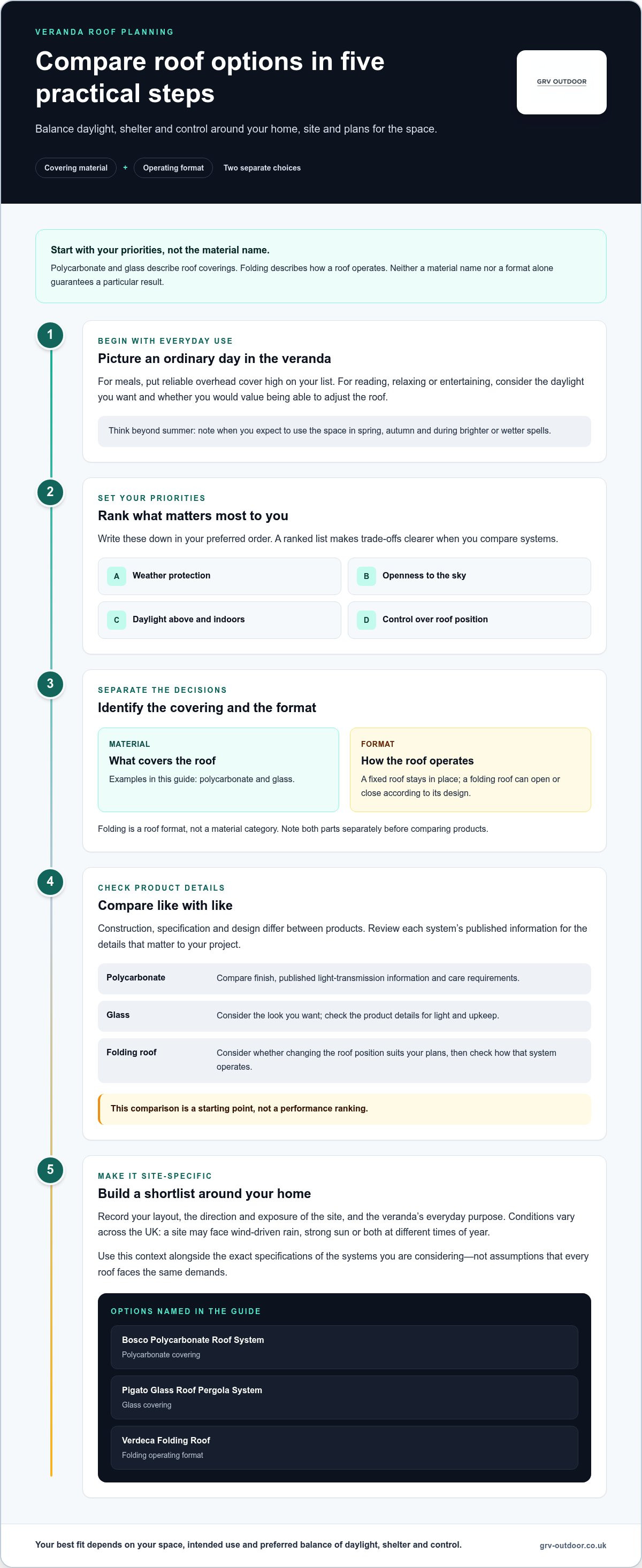
A practical UK checklist for choosing your veranda roof
A clear shortlist starts with the project, not the product name. Record the space you have, how the veranda connects to your home and what you want it to do. Then compare candidate systems against those details. This keeps the search for the best veranda roof material UK homeowners can choose focused on fit and priorities, rather than broad claims about what a material or roof type can do.
Define the project before comparing products
Write down the veranda’s intended use, available footprint and relationship to the house. Note whether it will attach to the property or sit separately, and sketch the layout you have in mind. Decide what matters most: fixed cover, flexible roof behaviour, daylight or overall appearance. Mark each requirement as essential or desirable so attractive extras don’t distract from what the space needs.
Review specifications and planning considerations
With your project brief ready, work through this shortlist in order:
- Set the intended use. Describe the main activities and when you expect to use the veranda. This gives every later comparison a practical purpose.
- Record the site. Measure the available width and projection, and note the attachment context, nearby doors or windows, and preferred layout. Treat these as starting details for comparing systems, not a substitute for product-specific design information.
- Rank your priorities. Choose which requirements are non-negotiable and which would be welcome. For instance, a fixed layout may be essential, while a particular visual finish could be a preference.
- Review product documentation. Compare the specifications for each complete system, including any stated structural requirements, drainage arrangements and maintenance guidance. Don’t transfer details from one product to another or assume category-wide performance.
- Consider planning context. Requirements can depend on the property and the relevant UK jurisdiction. Use the UK veranda planning permission guide for context, then consider the rules that apply to your specific project.
Specifications are most useful when read against your recorded dimensions and layout. A stated requirement may affect how a system suits the site, while maintenance guidance helps you understand its routine care. Keep a note of any point the documentation doesn’t answer, and avoid treating an assumption as a confirmed feature.
Before committing, review the intended use, site dimensions, attachment context, preferred layout, product specifications, structural and drainage requirements, maintenance guidance and relevant planning context.
Once your checklist is complete, compare it with GRV’s veranda roof systems to explore options that align with your priorities.
Explore GRV veranda roof systems once you know what matters
With your priorities and site details in hand, compare GRV’s veranda roof options by covering material and roof format. The best veranda roof material UK homeowners choose is the one that fits their brief, not simply the one with the most appealing name. Use each product’s information to assess how it aligns with your practical requirements, and don’t assume systems in the same broad category share identical specifications.
Match GRV roof options to your shortlist
If your shortlist points towards polycarbonate, start with the Bosco Polycarbonate Roof System. Its name identifies the covering category, while the product information sets out the details relevant to your project. For a glass option, compare the Pigato Glass Roof Pergola System and Pinela Glass against your preferred layout and the specifications provided for each.
Considering a roof that folds? The Verdeca Folding Roof is GRV’s option in that format. Keep your comparison focused on the priorities you’ve already recorded, such as roof behaviour, light and shelter requirements, and routine care. A product name helps identify an option, but its published information is what to use to understand its stated details.
- Polycarbonate on your shortlist: review the Bosco system’s product information.
- Glass on your shortlist: compare the Pigato and Pinela options.
- Folding format on your shortlist: explore the Verdeca system details.
Take the next step with a clear brief
Keep your decision brief close as you compare: preferred covering, fixed or folding roof behaviour, site dimensions, attachment context, layout and the practical requirements that matter most. Use it as a consistent reference across the relevant GRV product information. This makes it easier to see which details answer your questions and which need more consideration, without relying on broad assumptions about materials or formats.
If you’re also considering enclosing the space, glass doors are a separate decision. Explore the outdoor glass sliding doors UK guide to think through that aspect alongside your roof choice.
A considered shortlist gives you a more confident starting point. Compare the GRV roof system details with your brief, then explore the GRV outdoor living systems to find options that match your priorities.
Shape an outdoor space that works for you
Your veranda should feel like a natural extension of home, not a compromise you have to work around. Before deciding, picture how you want the space to feel during an ordinary week as well as on a bright day. That practical vision can help you choose the best veranda roof material UK homeowners can rely on for their own plans, without chasing a one-size-fits-all answer.
Keep your preferred roof behaviour and the details that matter most close as you review your shortlist. GRV designs and manufactures outdoor structures for customers across the UK, with polycarbonate, glass and folding roof systems among its options. Compare the product information with your brief and the character of your home.
Ready to take the next step? Explore GRV veranda roof systems and find a considered starting point for your outdoor space. A clear brief makes the choice easier and helps you focus on a system that suits your plans.
Frequently Asked Questions
Does a polycarbonate veranda roof yellow over time?
It can change in appearance, but the outcome depends on the specific panel, its finish, exposure and care. Sunlight, airborne dirt and cleaning practices may affect how a roof looks over time, so general comments about polycarbonate aren’t a promise about a particular system. Check the product’s current technical information and care guidance for details relevant to its panels and finish.
Is a veranda roof noisy when it rains?
Rain noise can vary with the material, roof construction, installation and intensity of the rainfall, so there’s no single answer for every veranda. A shower may sound different from prolonged, heavy rain, and the experience can also depend on how enclosed the seating area is. Review the published information for the specific roof system, then consider whether you’ll use the space during wet weather and what level of sound suits you.
Can you change a veranda roof without replacing the whole structure?
Possibly, but compatibility depends on the existing frame, dimensions, connections and the replacement system’s requirements. The best veranda roof material UK homeowners choose for a new project may not necessarily suit an existing structure. Gather the frame details and compare them with the replacement product documentation before planning a change. Don’t assume a roof can be retrofitted simply because its dimensions appear similar.
How should I clean a veranda roof safely?
Follow the care instructions for the exact roof product, and use only cleaning methods and products those instructions permit. Surfaces can respond differently, so don’t assume a method that suits one roof is suitable for another. Never stand or walk on roof panels; they may not be designed to support a person. If safe access is difficult, don’t attempt cleaning from an unstable position.
Can a veranda roof support snow?
Snow-load suitability depends on the complete system, its design, installation and the requirements for the individual project. Glass and polycarbonate roofs don’t all have the same capacity, so a general material description isn’t enough to establish suitability. Review the current technical documentation for the specific system and use its stated limits. Don’t rely on an unverified load figure or assume all roofs of one type perform alike.
Will a veranda roof need regular maintenance?
Care needs vary with the material, roof design, exposure and manufacturer’s guidance. Check the product’s maintenance instructions and follow its stated cleaning methods, rather than assuming there’s one schedule for every veranda. Routine surface care is separate from inspecting the structure or addressing damage. Product documentation should set out relevant care requirements; don’t assume a roof is maintenance-free or that cleaning alone covers every upkeep need.